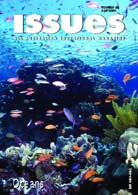
ISSUES 66, APRIL 2004
New Publisher for Issues
Editorial
Australia's Oceans Policy
National Oceans Office
Australia's Oceans Policy was launched in December 1998 to manage
16 million km2 of oceans between 3 and 200 nautical
miles from the coast - Australia's exclusive economic zone. At
the core of the oceans policy is the development of regional marine
plans. The National Oceans Office plays a key role in implementing
this policy through driving the development of regional marine
plans.
Turn the Tide
Australian Conservation Foundation
Our marine environment is subject to the vagaries of eight different
governments, numerous local governments and hundreds of different
laws. There is a compelling and urgent case for legislative and
administrative leadership and reform, and a suite of conservation
measures including a network of marine national parks.
Marine National Parks
Victorian National Parks Association
Victoria became a world leader in marine conservation when it
established a system of highly protected marine national parks
and sanctuaries in June 2002. The marine national parks system
is the result of 11 years of investigation, community consultation
and public debate, and it places Victoria at the forefront of
international efforts to conserve the marine environment.
The Benefits of Marine Protected Areas
Department of Environment and Heritage
The importance of marine protection areas and the need for better
management of coastal and marine environments has been recognised
internationally. Current management systems are failing to maintain
productivity and biodiversity within our oceans. However, the
effective management of marine protection areas can have significant
benefits for all marine stakeholders.
The Australian Seafood Industry
Department of Agriculture, Fisheries and Forestry
Australian fisheries are fortunate to operate in one of the world's
cleanest environments. Australia spans a number of climatic zones
giving rise to aquatic environments that can be broadly divided
into open ocean, reef, estuarine and inshore area, and freshwater
habitats.
|
 |
The Fishing Industry Today
Fisheries Research and Development Corporation
The Australian fishing industry includes many stakeholders with
competing interests - covering the commercial, recreational and
indigenous sectors. However, all three sectors have the common
interest of ensuring the long-term sustainability of Australia's
oceans, to ensure their lifestyle continues.
Shame on Australian Fisheries
Craig Bohm, Sustainable Fisheries Campaigner
for the Australian Marine Conservation Society
The Australian Marine Conservation Society welcomes a recent,
frank report released by the Australian Bureau of Rural Sciences.
The report questions whether Australia's Commonwealth-managed
fisheries are being managed sustainably, and looks to the government
for answers.
Seafood to Avoid and Questions for the Fish Merchant
Australian Marine Conservation Society
It is difficult to make a sustainable seafood choice. Although
a few fisheries have come a long way on the path to sustainability,
most have a very long way to go. This article provides you with
the information to make a sustainable seafood choice.
Fisheries Assessment and Guidelines
Environment Australia, Sustainable Fisheries
Assessment
The Australian Government has incorporated ecologically sustainable
development requirements into Commonwealth environment and fisheries
legislation, in response to ongoing concerns about the environmental
impacts of fishing and the risk of over-exploitation of marine
resources. These requirements include the independent assessment
of the environmental performance of fisheries management which
are prepared using the Guidelines for the Ecologically Sustainable
Management of Fisheries.
What is Seaweek? Discover Me in the Sea!
Marine Education Society of Australasia
Seaweek is an annual community education campaign organised by
the Marine Education Society of Australasia Inc (MESA), a non-profit
organisation. It is conducted each year to focus community awareness,
provide increased information and encourage an appreciation of
the ocean, its plants, animals and habitats. Seaweek aims to promote
safe, sensitive and sustainable use of the sea.
|